


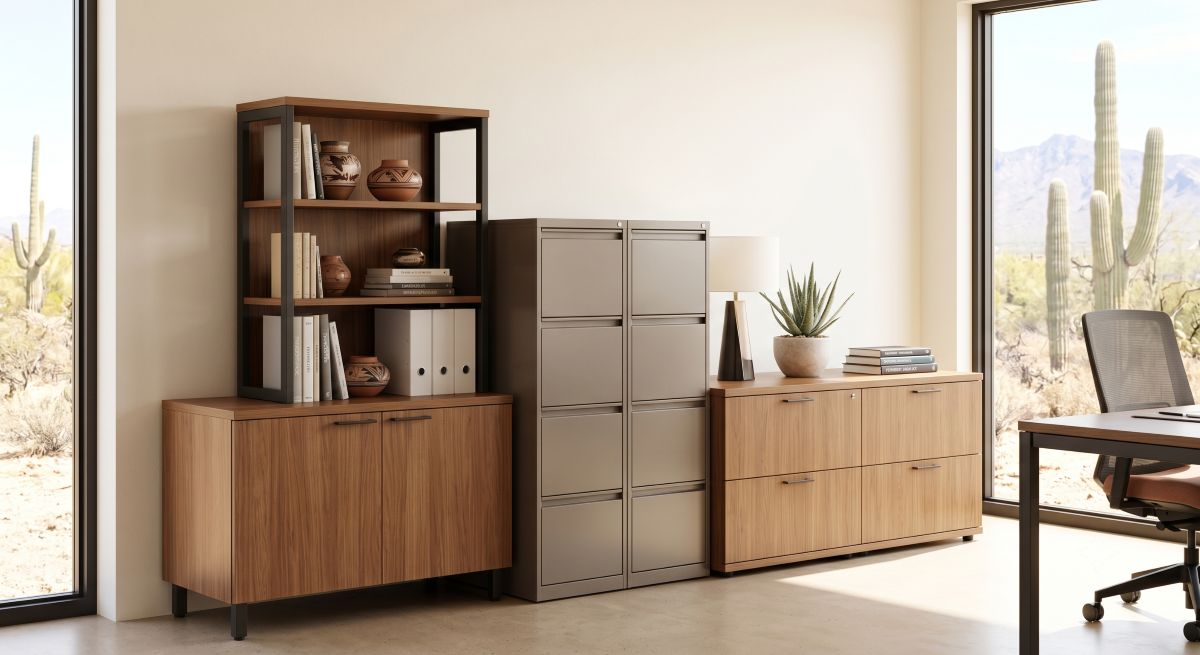
Office file storage cabinets are among the most underplanned items in a commercial buildout. Businesses budget carefully for desks, chairs, and conference furniture, then discover a few months into using the space that there’s nowhere organized to put anything. A practical storage plan solves that before you start buying, not after you’ve run out of room.
Why Storage Gets Shortchanged (and What It Costs)
Storage is easy to defer because it doesn’t feel as immediately critical as workstations and seating. You can’t run a meeting without a table. You can run a meeting without a credenza. But the cost of under-purchasing storage shows up quickly once a team is actually working in the space.
Files end up stacked on desks. Supplies take up workstation surface that should be used for actual work. Important documents go into boxes because there’s no organized place for them. Common areas absorb the overflow. Over time, the accumulation of unhoused materials creates clutter that affects how people feel about the workspace and how clients perceive the business.
The Three Types of Commercial Office Storage
Office storage falls into three categories, and each one serves a different purpose. Using the right type for each need keeps an office organized without buying more furniture than the space can hold.
Filing Cabinets: For Active, Accessible Documents
Filing cabinets are for documents that need to stay organized and retrievable on a regular basis. Within this category, the choice between lateral and vertical configurations matters.
Lateral file cabinets open from side to side and hold standard hanging folders arranged front-to-back. In most commercial settings, lateral files are the more space-efficient option because they provide more filing capacity per square foot of floor space than a vertical cabinet of the same height. A standard 36-inch-wide lateral file holds roughly the same volume as two vertical file drawers stacked, but in a lower-profile piece that also provides a usable flat surface on top.
Vertical file cabinets open front-to-back with one file row per drawer. They have a smaller floor footprint, which makes them better suited to individual workstations or areas where floor space is tighter than wall space. The tradeoff is that accessing files requires pulling the drawer fully out, which takes more clearance in front of the cabinet than a lateral drawer requires.
For any office handling confidential documents, client records, financial files, personnel records, or legal materials, lockable cabinets are the practical standard. A lock handles day-to-day access control without requiring a dedicated secure room.
Credenzas: Where Furniture Meets Storage
A credenza is a piece of furniture first and a storage piece second. The finished surface on top serves as a secondary work surface in a private office, a clean equipment surface in a conference room, or a display area in a common space. The cabinet space below conceals files, supplies, and equipment. In a private office, a credenza behind the desk effectively doubles the user’s functional working area while keeping daily storage within arm’s reach.
Unlike a filing cabinet, a credenza is designed to be seen. Select it with the same finish and style considerations as the desk or surrounding furniture. A lateral file belongs in areas where utility outweighs appearance: back offices or storage areas. A credenza belongs in client-facing and executive spaces.
In conference rooms, a credenza along one wall keeps AV equipment and supplies accessible without cluttering the table itself.
Open Shelving and Bookcases: For Reference Materials
Open shelving handles materials accessed frequently enough that enclosed storage creates friction: binders, reference books, physical samples, and anything staff reach for multiple times a day.
The functional advantage is visibility. Things are easier to find on open shelves than in filing drawers. The tradeoff is that open shelves require discipline. A well-organized bookcase looks professional. A disorganized one creates a visual impression of clutter even in an otherwise tidy office.
Open shelving works best in private offices and back-of-house areas where one person or a small team controls the organization.
Salt Creek’s bookcase collection includes options in a range of heights and finishes, suitable for both private office use and open commercial environments.
How to Calculate What You Actually Need
The most useful question before shopping for storage is: how much active filing do we currently have, and how much are we generating each year?
Start with a physical count. How many file drawers does your current operation use? If you’re relocating from an existing office, that count is your baseline. If you’re a new business with no existing files, estimate by industry type: most small businesses generate enough active paper to fill two to four lateral file drawers per year, though offices in legal, financial services, healthcare, and similar fields typically run higher.
Add roughly 25 to 30% to your current file count as a growth buffer. Under-purchasing storage and having to add to it later is more disruptive than starting with a drawer or two of empty space.
For credenzas, a practical default is one per private office and one per conference room where space allows. For open plan areas, one credenza per cluster of 6 to 8 workstations positioned along a perimeter wall adds storage without taking floor space from the center of the room.
For open shelving, count the reference materials your team actually uses on a regular basis rather than everything they might theoretically want accessible. Most offices overestimate their shelving needs and end up with partially filled bookcases that gradually collect miscellaneous items.
Coordinating Storage Finishes with the Rest of the Office
Storage furniture that coordinates with the desks and other pieces around it looks planned. Storage that was selected independently, without reference to the surrounding furniture, looks like a budget decision.
This matters most in private offices, where a credenza sits directly behind the desk and visitors see both pieces simultaneously. The credenza should match or closely coordinate with the main desk. If you’re buying from a coordinated executive suite collection (covered in Executive Desks and Credenzas: How to Buy a Suite That Matches), this is handled automatically within the collection. If you’re mixing pieces from different sources, verify that finish names are comparable and ideally check them side by side before ordering.
Filing cabinets in shared open areas don’t need to match workstations exactly, but they should stay within the same general finish family. A warm walnut workstation wall paired with a cool gray filing cabinet creates a visual break that feels like a mismatch rather than a deliberate contrast.
What to Do Before You Buy
The existing Salt Creek blog post on choosing between wooden and metal storage cabinets covers material selection in detail for buyers deciding between those two options. That article and this one are designed to complement each other: if you’ve read one, the other picks up where it leaves off.
Salt Creek’s file storage cabinet collection covers a range of lateral and vertical configurations in finishes suited to both private office and commercial open environments. Floor samples at both the Scottsdale and Gilbert showrooms make it easy to compare finishes in person before ordering, which is particularly useful when you’re trying to match a specific desk or credenza already in the space.
For the full commercial buying sequence that places storage in the context of a complete office setup, What to Buy First When Furnishing a Commercial Office in Arizona covers storage as the sixth step in the process. It consistently receives less planning attention than the five categories before it. Getting ahead of that pattern is the simplest way to avoid having to work around it later.
Salt Creek’s commercial team is available at the Scottsdale and Gilbert showrooms to help you work through a storage plan as part of a broader commercial office consultation.