


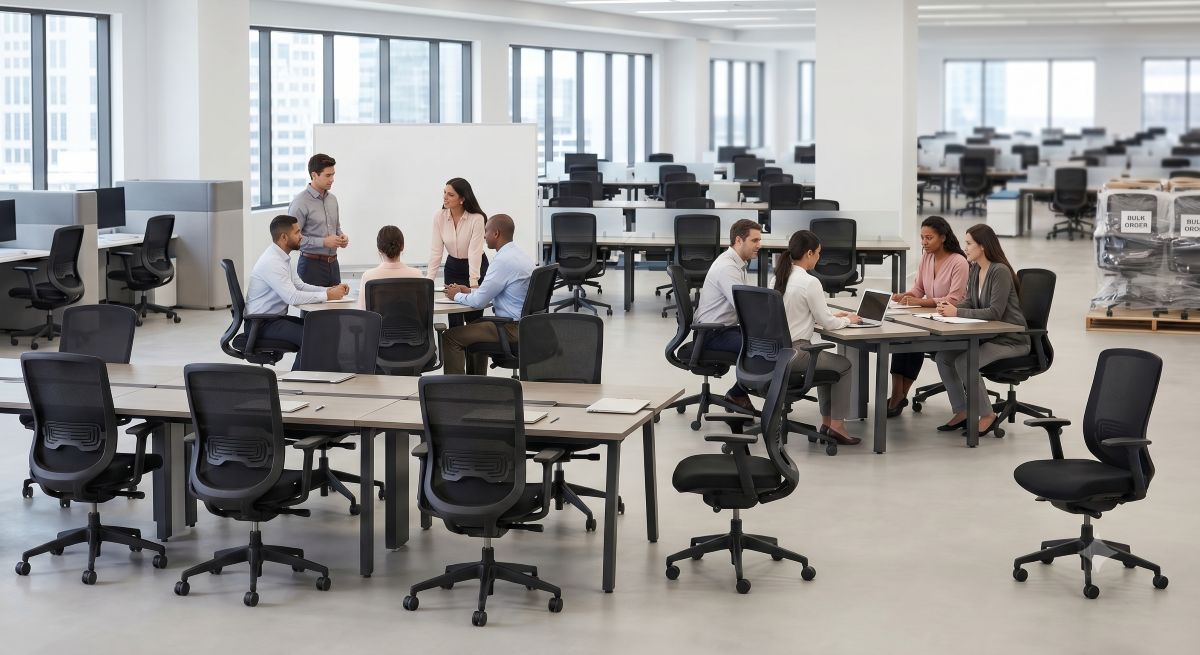
Buying office chairs in Phoenix for a team of 15 or 20 people is a fundamentally different process than buying one chair for yourself. The specs that matter shift, the stakes are higher when you get it wrong, and the factors you weigh when deciding where to invest are not the same. Here is what the process actually looks like when you’re outfitting a full commercial office.
Why Buying for a Team Changes Everything
When you buy a chair for yourself, you know your height, your weight, your sitting habits, and the specific discomforts you want to avoid. You can sit in a chair in a showroom for 10 minutes and develop a reasonable sense of whether it’s going to work for your body.
When you’re buying chairs for a team, you’re buying for people with different heights, different builds, different sitting habits, and different existing physical issues. A seat height that works perfectly for someone who is 6’2″ will leave a 5’3″ colleague with feet dangling and thighs unsupported. Lumbar support that hits the right spot for one person may press into the wrong place for another. A chair that feels supportive on a 30-minute showroom visit may stop performing adequately after 3 hours of actual daily use.
The practical solution is adjustability. When every chair in your office has a meaningful range of seat height, lumbar positioning, armrest configuration, and seat depth, most of your team can find a workable setup within that range. Without that adjustability, you’ll have some people comfortable and the rest gradually accumulating the back, neck, and shoulder strain that affects both productivity and retention.
This is not a small concern. According to NIOSH ergonomics guidance from the CDC, work-related musculoskeletal disorders account for roughly 29% of all nonfatal occupational injuries, with a median of 14 lost workdays per case. Seating is one of the most direct ergonomic interventions available to an employer, and one of the most frequently underinvested.
What “Commercial Grade” Actually Means
The phrase gets used loosely, but for office seating it has a specific technical meaning tied to BIFMA certification.
BIFMA (the Business and Institutional Furniture Manufacturers Association) sets the standard for commercial furniture testing. A chair certified to BIFMA standards has passed tests for seat and back strength under load, stability, armrest durability, seat cycle fatigue (how the chair holds up after thousands of sit/stand cycles over time), and base and caster performance. A chair that meets BIFMA certification was designed and tested for 8-plus hours of daily use in a commercial environment by a rotating population of users.
A chair that does not carry that certification, even if it looks similar and costs close to the same amount on paper, was not designed or tested for that level of sustained use. The failure mode is predictable: cylinders that lose pressure within two years, seat foam that compresses and stops providing support, casters that crack on commercial flooring, and mechanism failures that start as a mild annoyance and progress to unusable.
For a 20-person office, buying residential chairs to save on upfront cost typically means replacing most of them within 3 to 4 years instead of 10 to 12. Over a 10-year period, that is two full chair replacement cycles on top of the productivity and health costs of seating that stopped performing well years before it was replaced.
As BOSTONtec’s workplace ergonomics research notes, organizations that implement proper ergonomic programs, including appropriate commercial seating, see measurable reductions in injury costs and workers’ compensation claims. The ROI on commercial-grade chairs is not only a quality argument. It’s a financial one.
The Specifications That Matter Most at Commercial Scale
When you’re buying one chair, you can shortcut some of this and rely on “does it feel right.” When you’re buying 20 chairs for people you cannot personally evaluate in detail, the specifications become the proxy for fit.
Seat height range. A range from approximately 16 to 20 inches covers most seated adults. Wider ranges, such as 15 to 21 inches, accommodate a broader population and are worth looking for in any office with significant height variation across the team.
Adjustable lumbar support. A fixed lumbar pad is better than no support, but it will be in the right position for some users and the wrong position for many others. Lumbar support that adjusts independently in height and depth is the commercial standard worth looking for, because it allows each user to dial in the support to their specific torso length and lower back curve.
Seat depth adjustment. This allows users to move the seat pan forward or back to match their leg length, so that the seat edge doesn’t cut into the back of shorter users’ legs while still providing full thigh support for taller users. Most people don’t adjust this when they first set up a chair, but having the option matters across a diverse team.
Armrest adjustability. Height adjustment is the minimum. Width adjustment allows taller or broader users to set armrests at a comfortable shoulder width rather than forcing their arms inward or outward. Pivot or angle adjustment lets users match the armrest angle to their natural typing position.
Weight capacity. Verify the manufacturer’s weight rating for each chair model and make sure your selection covers the actual range of your team. Many standard commercial chairs are rated to 250 to 275 pounds. Higher-capacity options exist and should be included in the order for relevant users.
Do All Roles Need the Same Chair?
Not necessarily. The appropriate investment in ergonomic specification depends on how many hours a role spends seated.
Full-day desk workers benefit most from the full range of adjustability. If someone is seated for 7 to 9 hours a day, the quality of that chair has a direct effect on their physical health and focus. This is where spending more on commercial-grade ergonomic seating delivers the clearest return.
Part-time or shared workstation users still need commercial-grade durability, but the premium ergonomic specifications matter somewhat less if individual users are seated for shorter periods.
Conference room chairs have a different profile. Padded seats, basic lumbar support, and solid construction are the priorities. Full task chair ergonomics are not necessary here.
Reception and guest chairs need durability above all else. They see a rotating population of visitors with no individual adjustment. Structural integrity and upholstery quality matter more than adjustable features.
What to Do Before You Order for a Full Team
Seeing chairs in person before committing to a full team order is worth doing. An ergonomic spec sheet will not tell you how the lumbar adjustment actually feels, whether the seat cushion has the right density for sustained use, or how the mechanism responds at hour six of the workday. Sitting in a chair for 10 to 15 minutes in a showroom gives you that information.
Salt Creek carries commercial seating from 9to5 Seating and Global Furniture Group, both built specifically to commercial-grade durability and ergonomic specifications for sustained daily use. Both lines are available on the showroom floor at the Scottsdale and Gilbert locations for you to test before placing a full order.
If you want to go deeper on the individual ergonomic features that separate a good commercial task chair from a mediocre one, the Salt Creek blog’s deep dive on ergonomic office chair features covers the full specification breakdown with detail on lumbar mechanics, tilt systems, and what each adjustment actually does for the body over the course of a long workday.
For the broader buying sequence that puts seating in context alongside desks, conference furniture, and reception, see What to Buy First When Furnishing a Commercial Office in Arizona. Seating is the second step in that sequence, not because it matters less than desks, but because the desk configuration determines exactly how many chairs you need and what seat height range each workstation requires.
Visit Salt Creek’s office chairs collection to browse the full commercial seating range available for Phoenix-area businesses.