


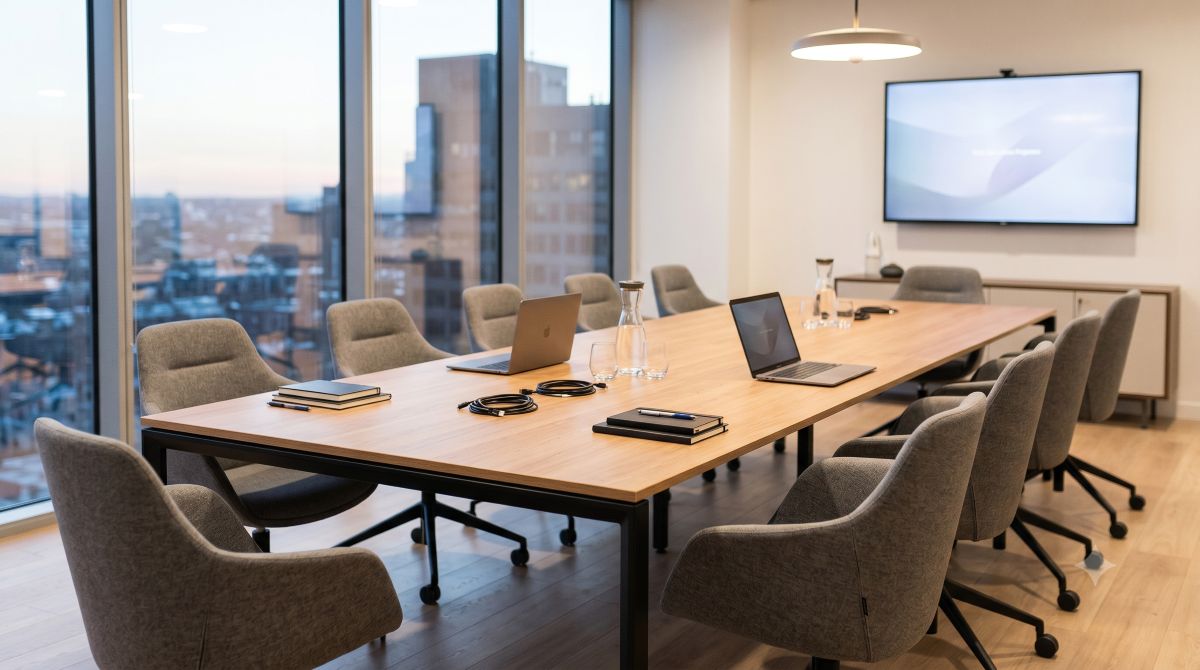
Choosing conference room tables in Arizona starts with a measurement, not a catalog. Knowing your room’s exact dimensions before you start shopping is what separates a meeting space that functions well from one that looks good on paper but leaves attendees pressed against the wall. Get that number right first, and every other decision follows naturally.
Start with the Room, Not the Table
Most buyers approach this backwards. They decide how many people they want to seat, then search for a table that seats that number. That approach gets the logic wrong. Your room determines the maximum table size. The table size determines how many people you can seat comfortably. Working in that order saves a significant amount of frustration.
The standard calculation: subtract at least 7 feet from both the length and width of your conference room. That accounts for a minimum of 3 to 3.5 feet of clearance on each side of the table, which is what you need for someone to push back a chair, stand up, and walk behind a seated person without disrupting the meeting. What remains is your maximum table footprint.
A room measuring 14 feet by 12 feet can support a table up to roughly 7 feet by 5 feet. A room measuring 20 feet by 15 feet opens up options up to about 13 feet by 8 feet.
If you want to work from a seating goal instead: plan for 24 to 30 inches of table edge per person. Someone bringing a laptop, a notebook, and a coffee needs the full 30 inches. A meeting where most participants are just engaging verbally can work at 24 inches per seat.
How Table Shape Affects the Room
Once you know your maximum dimensions, shape is the next decision. Conference table shapes are not just aesthetic preferences. They affect sightlines, seating capacity, and the dynamic of every conversation that happens around them.
Rectangular tables are the most common choice for practical reasons. They seat the most people per square foot, fit naturally in rectangular rooms, and create a clear head-of-table orientation that suits presentations, structured agendas, and meetings with a defined leader. For groups of 6 to 20 people, a rectangular table is usually the default that will serve you well.
Boat-shaped tables have sides that bow gently outward toward the middle. That curve improves sightlines for everyone seated along the length of the table, which matters more as the table gets longer. In a 12- or 14-foot boardroom table, people at the far ends can feel disconnected from the center of the conversation. The boat shape reduces that disconnection. It’s a common choice in larger boardroom settings where visual engagement across the full table matters.
Round tables work well for smaller groups, generally up to 8 to 10 people, where equality of participation is more important than seating efficiency. With no head of the table, round configurations tend to produce more open, egalitarian discussions. The limitation is that large round tables require significantly more room area per person than rectangular tables, because the diameter grows quickly as you add seats.
Square tables suit small, informal meetings of four to eight people. The uniform distance between everyone keeps the conversation easy and connected, which makes them practical for team check-ins, one-on-ones, and quick working sessions.
What Seating Capacity Do You Actually Need?
Before you size for your maximum possible meeting, think about your typical meeting. If your team of 12 holds a weekly all-hands, you need a table that seats 12. If most of your daily meetings are with 4 to 6 people and the 12-person all-hands happens quarterly, there may be a case for a smaller primary table with a plan for occasional larger gatherings.
Most commercial offices need more small meeting rooms than large ones. A space for 4 to 6 with a 6-foot table gets daily use. A boardroom for 16 that sits empty most of the week is an expensive commitment of square footage.
If your office has only one meeting space, size for the meetings you hold most frequently.
Technology Belongs in the Planning Phase
The most significant shift in conference room furniture over the past several years is not a style change. It’s the growing reality that many participants may be joining remotely, and a table that doesn’t account for that creates friction every time someone runs a hybrid meeting.
Before you finalize a table, work through these questions:
- How many seats need power access? Ideally every seat where someone might plug in a laptop, not just one central hub.
- What connections are needed? Standard outlets, USB-A, USB-C, and HDMI cover most situations.
- Where do cables go? A table with no routing solution means cables draped across the surface. Look for tables with in-table grommets and internal cable channels.
Salt Creek’s conference table collection includes options with integrated power solutions as well as custom round table configurations made in Phoenix for offices that need something built to specific room dimensions.
Does Style Matter in a Conference Room?
Yes, but style works best as an extension of your overall office design rather than a separate decision. A conference table that uses the same or coordinating finishes as your private office furniture, reception desk, and workstations makes the whole office feel cohesive and considered. One that clashes makes the conference room look like it was sourced independently.
For most commercial Arizona offices, the practical finish range runs from traditional wood tones (rich cherry, dark walnut, warm mahogany) to transitional options (lighter maple, medium oak, gray-toned laminates) to contemporary surfaces (high-gloss whites, darker charcoal finishes). The material that holds up best for a conference table surface in commercial use is typically a high-pressure laminate over a solid core. It resists the wear that comes from years of laptops, elbows, and coffee cups better than most solid wood alternatives.
If you already have a private executive office with established furniture, the conference table doesn’t need to match it exactly. But it should at least not fight with it. A warm mahogany desk 20 feet away from a cool-gray conference table creates a visual disconnect that clients register even when they can’t quite articulate why.
The Supporting Furniture That Makes a Conference Room Work
The table and chairs are the primary purchase, but what surrounds them affects how usable the room is day to day.
A credenza positioned along one wall gives you a surface for AV equipment, video conferencing hardware, presentation materials, and any refreshments you set out for meetings. It also keeps those items off the table itself, which matters when the table is in use and you need clear space. Underneath, the cabinet storage handles supplies, chargers, and anything else that the room needs but shouldn’t be visible during a meeting.
Conference chairs deserve more attention than most buyers give them. A chair that feels fine during a 30-minute check-in starts to feel less forgiving in a three-hour planning session. Commercial-grade conference chairs with padded seats, some lumbar support, and appropriate height for your table thickness are worth the investment, particularly if your team uses the conference room for extended working sessions.
For context on how conference furniture fits into the full commercial office buildout, What to Buy First When Furnishing a Commercial Office in Arizona covers the buying sequence from workstations through storage.
Salt Creek’s teams at both the Scottsdale and Gilbert showrooms can help you work through a conference room layout before you commit to any table.